Before you head out on a road trip, make sure you won't be accidentally breaking the law.
Nudphon Phuengsuwan/Getty Images
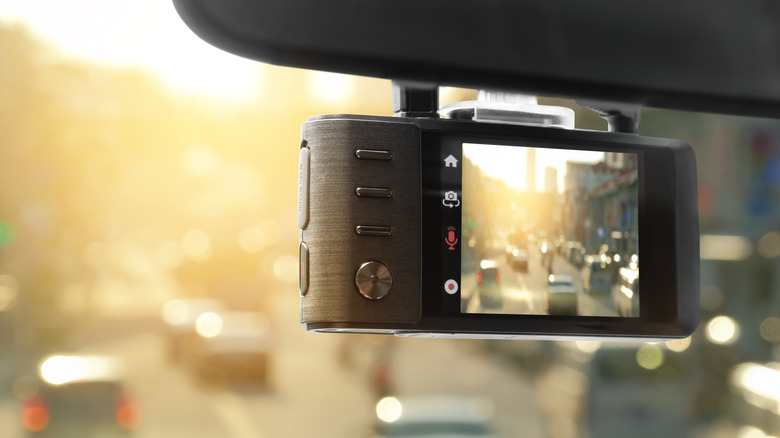
Dash cams are useful for so many reasons. They capture footage while you're driving, and some record motion even when you're parked. The footage one captures can prove invaluable in the event of an accident or break-in, since the recording can be presented as objective evidence. Yes, dash cam footage that is captured in a public place and can be authenticated should hold up in court. That's the main purpose of using one. But along with safety and record-keeping, you could use one to monitor driving habits of teens, capture other incidents that happen to occur in its view, like road rage or fraud (think someone jumping in front of the car to claim injury), or even just record the beautiful scenery on your drive. While dash cams are legal in every state, there are specific rules about how you can use them, where to position them and even their size that vary from state to state.
Even if you know the laws in your own state, if you're driving out of state for a road trip, it's important to know the laws in others. The last thing you want is to be driving with a piece of equipment positioned or being used illegally in your car.
The rules around dash cam use
rukawajung/Shutterstock
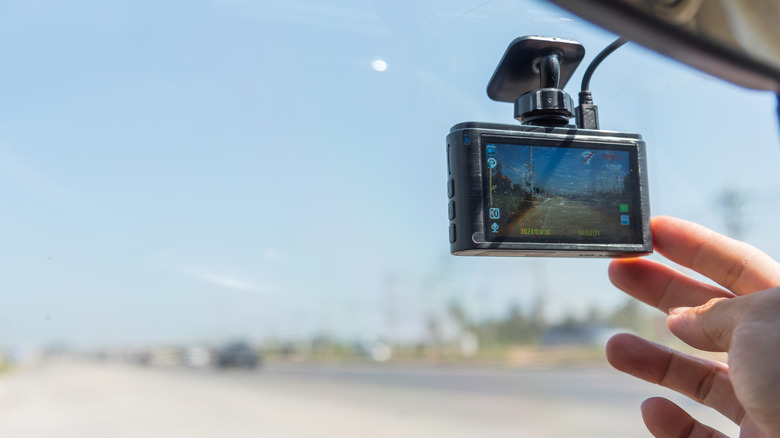
The rules when using dash cams in different states vary considerably. The simplest and most logical rule is about positioning, requiring that a dash cam not obstruct the view of the driver. This rule explicitly applies in Alaska, Arizona, California, Florida, Hawaii, Illinois, Indiana, Iowa, Kansas, Kentucky, Maine, Maryland, Missouri, Nevada, North Carolina, Utah, and Vermont. However, it's a logical rule you should follow everywhere. Some of those states have specific rules about camera placement beyond ensuring it doesn't obstruct your view. In California, for example, a dash cam has to be mounted in a seven-inch square on the lower corner of the windshield, away from the driver, a five-inch square in the corner nearest to the driver, or in a five-inch square in the upper-center. Meanwhile, in Illinois, a dash cam must be in the bottom corner of the windshield on the passenger side. In some states, like Alabama, Delaware and Louisiana, the dash cam can't even be mounted on the windshield at all, while states like Pennsylvania and Minnesota forbid having anything mounted on a windshield, period. In these cases, it has to be mounted on the dashboard. So, it's important to check positioning rules in your state.
There are also size requirements, with most states requiring that a dash cam be smaller than five inches. Some states, like Hawaii, permit dash cams as large as 7 inches, while in Indiana, it can be no more than 4 square inches.
When it comes to use, in 13 states, you can't record conversations in a vehicle unless every passenger in it consents. The 13 states where this two-party or all-party consent rule applies are California, Delaware, Florida, Illinois, Maryland, Massachusetts, Michigan, Montana, Nevada, New Hampshire, Oregon, Pennsylvania and Washington. Other states have rules about recording that you should pay attention to as well. In states like New York and many others, recording video from a dash cam is fine. But audio conversations are not permitted without at least one party's consent. This might not matter much for family road trips, but it's something to consider if you're traveling with colleagues, carpooling with others outside your family, or are a ride-share driver.
How to prepare for a drive
Toa55/Getty Images
Because there's no single federal rule about dash cam usage and installation, you need to be cognizant of the specific rules in any state you're traveling to or even through to ensure that you adhere to the local laws. Your best bet is to use the most stringent rules of any of the 50 states and adhere to them to avoid problems while you travel. California is a good benchmark to use, since it's widely considered to have among the strictest laws for dash cam placement and usage.
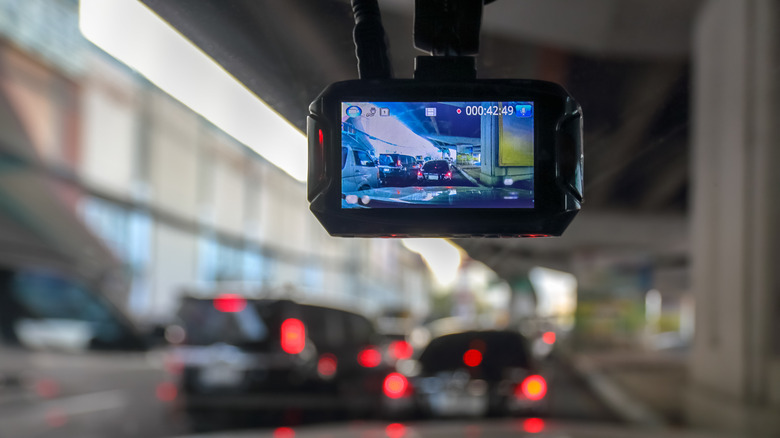
The good news is that dash cams in general are legal to have and use in every state, so simply having one won't get you nabbed for doing anything wrong. Just make sure it doesn't obstruct your view in any way, and get a small 4- or 5-inch model. Consider mounting it on the dashboard instead of the windshield if you're worried about positioning. Another option is to mount it behind the rearview mirror. If placed here, the dash cam doesn't obstruct any part of your view that isn't already obstructed by the mirror itself. Use a mount that's easy to remove and reposition if you must do so to adhere to local law as you're passing through.
Before you head out on the road, if you're crossing state lines, map your route. Then check the state Department of Motor Vehicles (DMV) website to see the specific rules in each state when it comes to dash cams. From there, position the dash cam according to the strictest rule for visibility. If necessary, disable audio recording if you're entering a state with two-party consent rules, or make clear to everyone in the vehicle that audio is being recorded. With proper preparation, you can get the most out of your dash cam and make sure you're following the law, no matter where you are.