
Tablets can introduce problems for kids, but they’re not always bad.
Pixar
After five films, digital technology has finally arrived in the cloth-and-plastic world of Toy Story. But the film, directed by franchise veteran Andrew Stanton and McKenna Grace, mostly avoids the easy trope of making technology inherently bad. Instead, it's a disruptive force that can be either helpful or harmful, depending on how it's used. The film makes the case that parents need to take a hands-on approach to help kids manage their gadgets, especially when it comes to managing screen time or dealing with bullying.
Slight spoilers ahead for Toy Story 5.
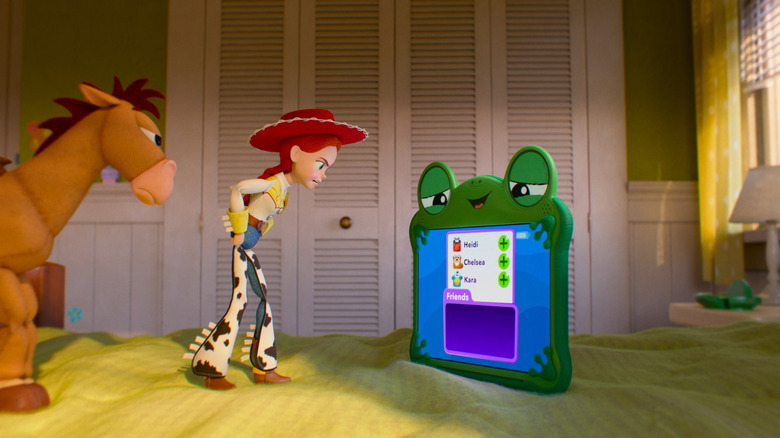
Toy Story 5 centers on Bonnie, a young girl struggling to make friends who was gifted Woody, Buzz and Andy's other toys from the first three films. She's the only kid in her neighborhood not using a Lilypad tablet — instead, she prefers to play the old fashioned way, by crafting scenarios purely out of her imagination. Her parents reluctantly decide to get her a Lilypad (played by Greta Lee) as a way to connect with other kids.
Like a McKinsey consultant storming into a quaint local business, Lilypad decides she knows the best way for Bonnie to make friends. The tablet sends friend requests to several girls Bonnie knows, and she miraculously gets an invite to a sleepover. But instead of playing together, all of the girls just zone out endlessly on their Lilypads, barely saying a word to each other. Those same girls later start bullying Bonnie for playing with older toys, which leads to Bonnie's parents wisely disabling the Lilypad's social network access.
 Pixar
Pixar
It might seem crazy that parents even have to worry about social networking for 8-year-olds, but platforms like Zigazoo and JusTalk Kids already exist. They market themselves as safe spaces where kids can chat with close friends and family members, but there's still room for awful social dynamics. Kids will be kids, and many of them are little jerks.
While Lilypad stumbles to help Bonnie connect, older toys like Cowgirl Jessie (Joan Cusack) also realize they're out of touch with the way kids play today. When Jessie tries to sneak her way into Bonnie's sleepover, she immediately becomes a source of shame.
Research shows a relationship between managing anxiety and imaginative play in kids, and Toy Story's main cast make convenient messengers for that information. But the film surprised me by finding ways to make room for Lilypad and other new devices. A messageboard app on Lilypad helps Bonnie connect with Blaze, another young girl who still plays with toys the old fashioned way. Without Lilypad, they probably never would have met.
It's hokey, but it works in the context of the film. And it's also the reality parents have to live with today. Despite their potential harms, it's helpful for kids to sometimes watch TV on the go. There are tons of educational games on iPadOS and Android, and both platforms also have a bevy of video chatting apps for staying in touch with friends and relatives. The key is moderation and parental supervision.
Toy Story 5 would be even more of an insightful critique if it made room for new types of play. Lilypad just has a few basic games for kids. But these days, any iPad can play Minecraft, a game that is appealing precisely because it so closely mirrors imaginative play. It's also complex enough to grow with kids into adulthood, more so than the likes of Woodie and Buzz Lightyear.
Now that tablets have entered the world of Toy Story, it's unclear where the franchise can go next. Pixar has already wrung the series' core concept dry. We've explored the inner lives of toys, we've seen them wrestle with the meaning of their existence and they've even confronted death directly. (Toy Story 3 must have traumatized an entire generation.) Toy Story 5 isn't nearly as essential as the original trilogy, but at least it's a reminder to parents that they can't just sit back and relax when it comes to tech.