Spotify's DJ-inspired tools are loads of fun, but probably won't land you any bar mitzvah gigs.
Max Miller for Engadet
Though more accepted as an art form than ever before, it's easy to perceive DJing as a trivial pursuit. But although it can appear to primarily involve jumping around and pressing play, the best DJs put hours of work into crafting a set that will flow seamlessly from one song to the next while managing the crowd's energy throughout the experience. One of the most difficult elements to master is the basic act of mixing between songs. Without proper transitions, a DJ set feels jarring and disjointed, but when mixed properly, it feels like a curated experience. To that end, transitions need to occur between tracks that are compatible with one another, both rhythmically and melodically. They also need to tame both songs, since simply playing one atop the other can end up sounding harsh and chaotic.
All these complexities mean that most people will require some amount of practice with costly equipment before DJ mixing begin to feel natural. But a new feature from Spotify aims to make complex DJing accessible to just about anybody. Somewhat unimaginatively called Mix, it's now widely available to Premium subscribers on both mobile and desktop apps, alongside other new improvements to playlists. Digging into Mix as a hobbyist DJ, I expected to feel somewhat annoyed, but Spotify has executed the feature surprisingly well, striking the right balance between user friendliness and functionality.
Unlike actual DJing, Spotify Mix doesn't let you mix in real-time. Instead, it lets you permanently set transitions inside of user-created playlists, adjusting timing and effects for each transition. Mixing an entire playlist this way can be a tedious process, but the result is a listening experience that's both bespoke and shareable. Grab a glowstick and read ahead to try it out for yourself.
Spotify's Mix feature gives you a taste of DJing without expensive equipment
Max Miller for Engadget
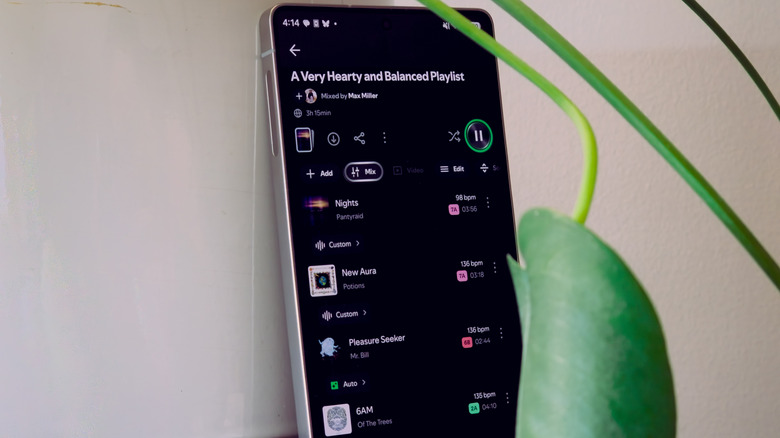
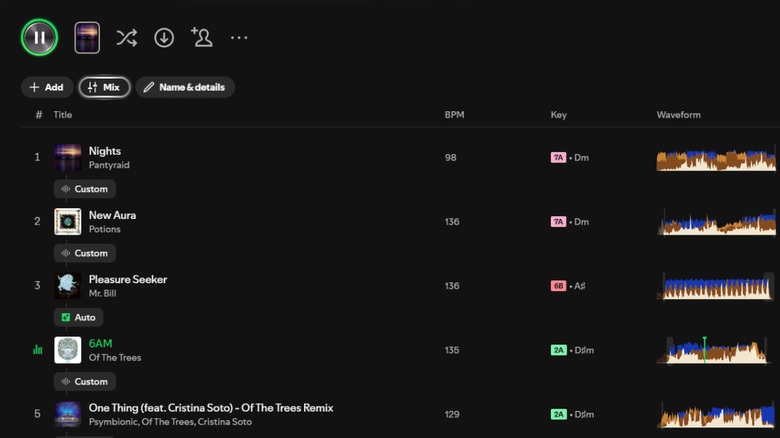
Spotify Mix only works on playlists you make yourself. You can't use it with your Discover Weekly, Daily Mixes, Release Radar, and so on, unless you save one of those generated mixes to its own playlist. Inside compatible playlists, you can toggle on Mix mode by selecting the Mix button from the row of controls under the play button. Spotify will immediately create AI-generated transitions between each song, which you can leave intact or treat as a jumping-off point for your own ideas.
Before mixing, it can be helpful to arrange the songs in your preferred order. This will eliminate the need to redo any of your work later on. Alongside each song, Mix shows its tempo in beats per-minute (BPM). It's helpful to put songs with similar or identical BPMs next to one another for easier transitions. Spotify's new Smart Reorder feature is handy here, and you can tweak manually from there.
Each song's key will also surface in Mix mode, but not only with standard musical notation. Many DJs use a shorthand called Camelot Key, where each musical key is notated by number, 1 through 12, and is accompanied by the letter A for minor keys or B for major. For example, B-flat Major becomes 6B. The upshot of this is that you can quickly look at the Camelot Key of two songs and intuitively understand whether they'll mix well together. In general, moving forward a number shifts the energy of a set up, while moving backward chills things out, and you can switch up a set's mood by moving between A and B. If you want to get more comfortable with Camelot Key, DJ Studio has a more in-depth explainer.
How to mix transitions in Spotify
Max Miller for Engadget
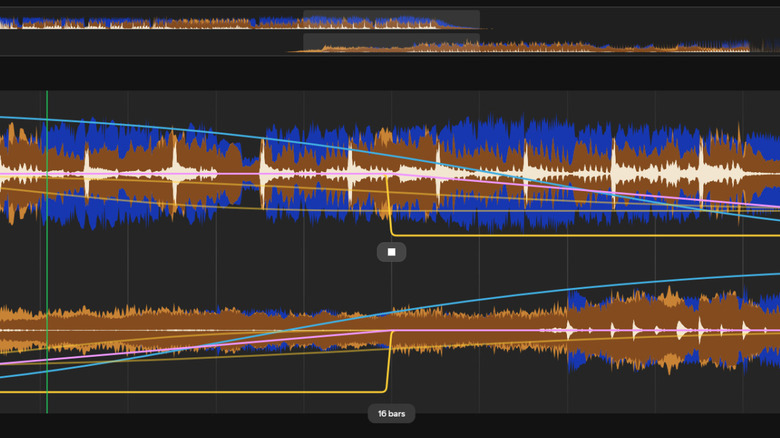
With your playlist sorted into the order you'd like to mix it in, you're ready to tweak the transitions. To customize a transition, select the Auto button between the two songs you'd like to mix. This will surface a mixing panel where you can see the waveforms of the two songs, zoomed in on the area where the transition occurs. When you enter the mixer, you'll hear and see the transition Spotify's algorithm came up with.
You can drag the waveform of each song to choose when the transition occurs. Many songs will also show beat markers along the waveform, allowing you to easily align beats. Above the waveforms, you'll see a zoomed out overview of the songs, helping you to contextualize where within the songs you're mixing. You can drag them to scrub the tracks, too.
Below the main waveforms, you'll see a few generic mixing presets — Fade, Rise, Blend, and so on — which can be good starting points. There are also three controls for Volume, EQ, and Filter. You can choose from between seven and nine presets for each of those parameters, mixing and matching until you find what sounds best. On the mobile app, you can then tap Customize in each preset menu to granularly adjust the curves for each effect.
Once you're finished with a transition, tap Save in the upper right to keep it. If you've made a mistake and want to put things back the way they were, tap the 'X' button instead, then tap Discard.
To hear a playlist with your transitions, ensure the Mix option is turned on and that shuffle is turned off. To hear the playlist without any transitions, toggle Mix off from the playlist's controls.