Halliday hopes it can regain trust after its universally-panned debut.
Halliday
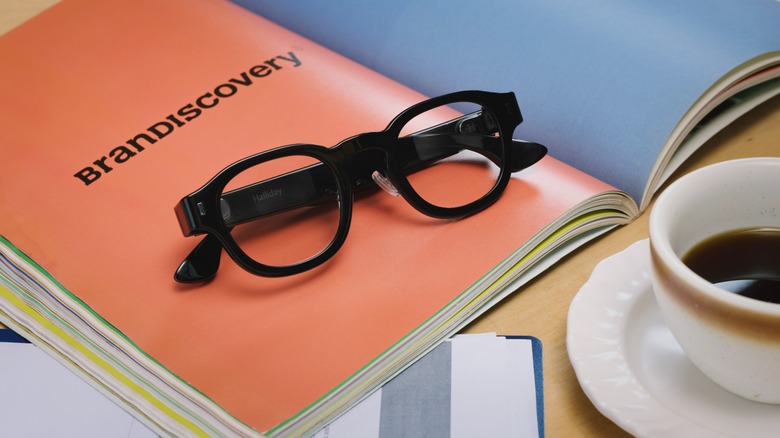
What do you do when you've made 2025's worst pair of smart glasses? You build your second pair, hopefully resolving some of the most egregious flaws.
Halliday made a splash at CES 2025 with a pair of lightweight smart glasses controlled with a ring. Sadly, when it made its way into people's hands, it was almost universally panned. Android Police gave it 5/10, TechRadar said the only plus was the stylish frame, and I gave it a score of 54, one of the lowest in Engadget's long history. It wasn't just the critics who were unimpressed;
You can imagine my surprise when I was invited to speak with Halliday COO Carter Hou about the company's second-generation hardware. During our chat, Hou explained that he is focused on what he's learned, and what he's sought to put right with these new glasses, as well as a new direction for the company.
What went wrong
Daniel Cooper for Engadget
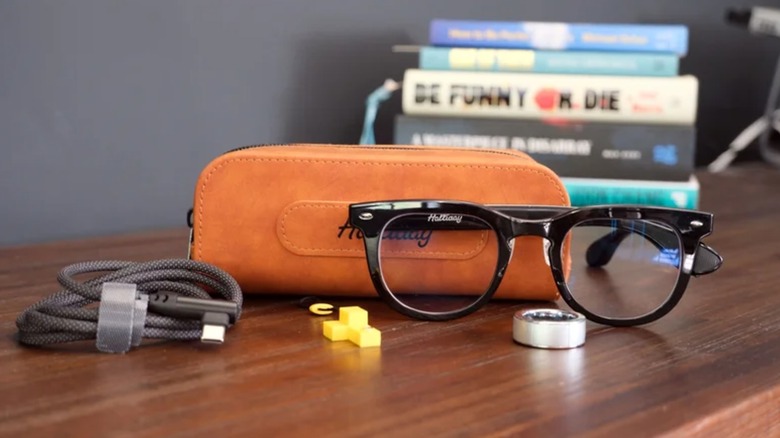
Hou admitted to making "many mistakes," adding that the first generation glasses were "far from what we expected." Many of the issues were obvious to outsiders from the start, like the DigiWindow display; a 3.6mm microLED module embedded in the frame. It was intended to "project" text into your peripheral vision, that you could just flick your eyes and look at when required. But if you've ever tried reading text hovering mere millimeters from your eye, you'll get why it was an unusable nightmare. There's a reason every other smart glasses worth talking about uses waveguides that aim their outputs into your direct field of view.
Hou said the DigiWindow was the "right choice" when the glasses were designed in 2024, due to the prisming effects, light leakage and battery drain associated with waveguides. I'm not sure I agree given the number of very good waveguide glasses that were already in the market by then. Now, however, the new model uses waveguides in both lenses, which gives users a bigger field of view and better readability.
With last year's glasses, Hou prioritized lightness, opting to use small, but low-quality components that wound up spoiling many other elements of the experience. Other mistakes involved inexperience, like the manufacturing issues that held back the release. "As a newcomer to the industry," said Hou, "we didn't speak [the manufacturer's] language and didn't know how to control the process." Consequently, Halliday has rebuilt its engineering team, complete with experienced supply chain managers "that can properly collaborate with our partners this time."
Hou is aware the company didn't do enough testing and QA, either. "Even though the software worked fine on a demo, when it goes into the hands of thousands of consumers [...] I would say we did not do enough testing." It wasn't just that the features were unreliable, either, but there were so many of them that the company had to spread its finite resources thin.
Halliday G2
Halliday
This time around, the company wants to ensure the fundamentals are there, with better-quality hardware, more reliable manufacturing and a more solid OS.
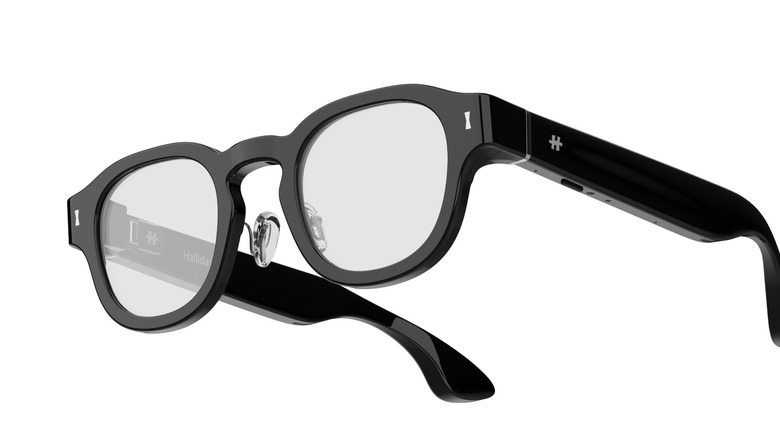
Specs-wise, the new Halliday G2 uses a pair of prescription-ready lenses with waveguide prisms and a battery rated for 12 hours of heavy use. There's no camera (as before, what a mercy!) and the company says it has improved audio recording and playback, with Hou saying the new model is comparable to Meta's offerings. Given one of my biggest gripes with the older glasses was its terrible audio, this was welcome news.
Halliday's also tweaked the hardware to focus on voice, so it should be better at listening to your commands. The dreaded built-in USB-C charging port with its impossible rubber gasket is gone, too, replaced with a charging clip that connects to the glasses with pogo pins.
As for the features, you'll get the very basic things you would expect from glasses in this category. Notifications, audio playback, phone calls, teleprompter and real-time translation as well as the proactive-AI. One notable omission is navigation, which Hou said is a decision borne out of this newfound pursuit of focus. "Navigation sounds like an easy choice, but it is actually very hard to make it good," said Hou.
This time out, there's no ring, and the ring that shipped with the G1 glasses won't work with the new model. "Unfortunately, they can't. It's just something not possible on this platform," said Hou. Instead, a touchpad runs along the side of the right arm, which will also accept gestures such as covering the touchpad with your whole hand. There's also a power button which pulls double duty as a trigger for the glasses' low-light mode, designed for when you want to mute the screens when you're in a theater.
Pivot to business
Halliday
The other part of the equation is the flotilla of AI agents running in parallel to help you with Halliday's new focus: Meetings. "There are already a lot of AI solutions for meetings on the market," Hou said, "but all of them are focused on afterward." He added that "there's no way for a gadget like Plaud to help you during the meeting." It's this gap the company wants to exploit, using its AI to help people have more effective meetings.
The way Halliday put it, when in meeting mode, a series of agents will be analyzing the transcript of your conversation. One agent might keep track of each thread, marking when a decision is made; another agent may prod you to get a firm commitment on action items if they've been left up in the air — all before before the meeting ends. Halliday hasn't given up on the promise of its proactive agent, either, so when someone asks a question in the room, it'll do its best to offer up an AI-generated answer. Naturally, when you're all done, you'll get the usual AI-generated summary and transcript delivered to your app.
Money
It's rare that small, crowdfunding-backed hardware startups get any sort of second chance at making a first impression. And you wouldn't be unwise to have concerns about actually receiving a unit after purchasing the G2. I asked Hou what Halliday's financial situation looked like and was reminded that he has a relationship with Moody Lenses, "a successful contact lenses brand [...] and it is generating positive revenue and profit. So we are not that short on cash," said Hou.
As part of this, Hou says an initial early production run has already been completed, with test hardware sent to early beta testers. Those users are spread around the world, with the hope that by the time the production run is ready to go, it's "ready for use and a mature product on day one," he added.
Halliday Generation 2 will retail for $599, but the company will only require a $10 deposit from early backers on its website. If you do put your money up early, you'll get a $100 discount on the aforementioned retail price, too. Hou has promised the company will only take the full amount when the full production run is ready to go. If you already own a G1 pair of Halliday glasses, you'll be able to buy a pair for half price ($299).
Halliday is expecting shipments to begin in September, and we will hopefully be able to test them in the run-up to the launch to offer our opinion.