The format remains unique in console history.
Cromatoki/Shutterstock
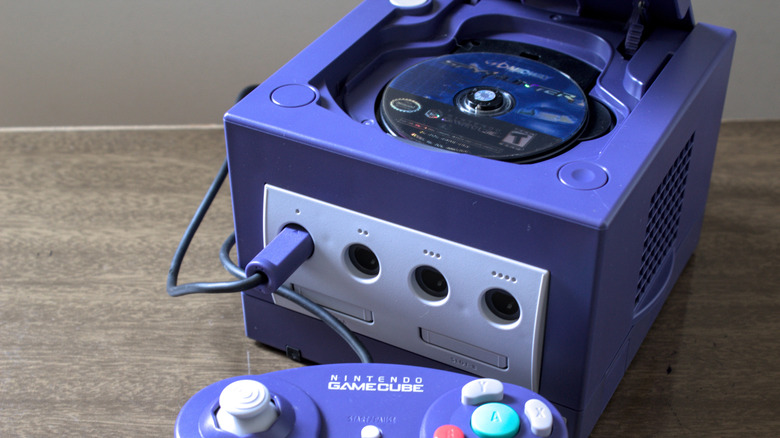
The GameCube is one of Nintendo's most beloved consoles. How could it not be? That iconic startup screen! It's adorable, oh so teeny design! The fact it had a handle! The Wii may have sold far more units than its iconic purple predecessor, but if it wasn't for the GameCube, there's a good chance Valve's cute and cuddly (if underpowered) Steam Machine would look very different. Another thing that really separated Nintendo's system from the competition? Its bespoke little discs.
Rather than go with DVDs like the PS2 and Xbox, the GameCube used a proprietary form of disc that remains unique in console history. Though the type of disc Nintendo chose may have ultimately hurt system sales, it also led to benefits, like shorter loading times. Let's break down why the GameCube had such small discs, before examining the pros and cons of the Big N's decision.
What discs does the GameCube use?
Snap Spot/Shutterstock
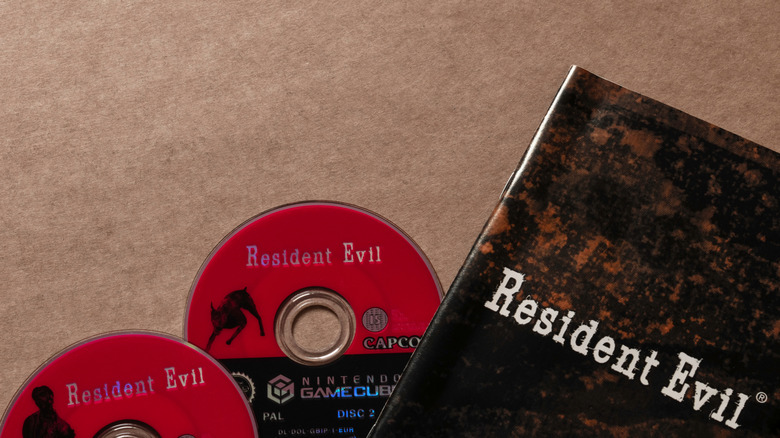
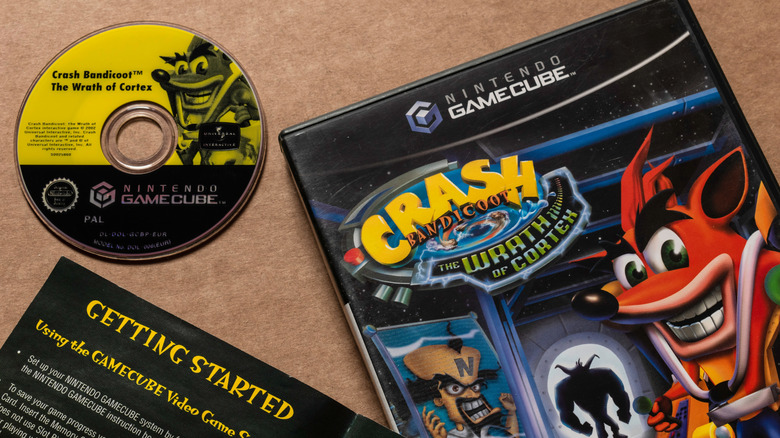
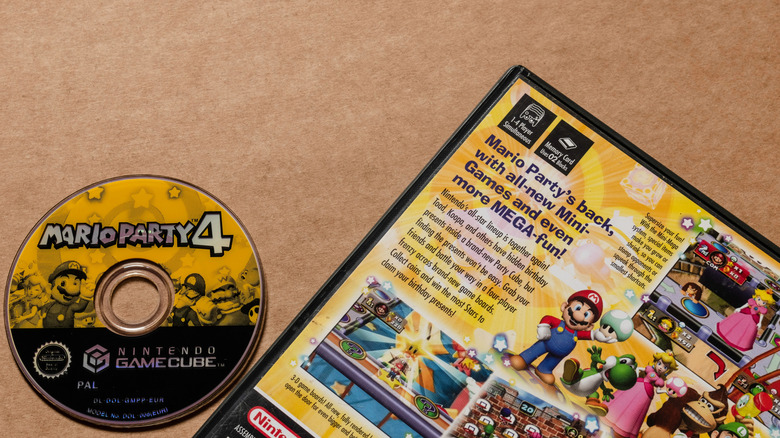
Nintendo opted for proprietary miniDVDs when manufacturing the GameCube. Sometimes known as "GameCube Optical Discs", they were significantly smaller than standard DVDs. Measuring in at just 3.15 inches in diameter — DVDs are 4.17 inches — GameCube discs couldn't be read by standard DVD drives. This meant they were harder to pirate, which we'll touch on shortly.
These bespoke miniDVDs had a capacity of just under 1.5GB, which is a miniscule amount of data compared to modern standards (PS5 Blu-rays can hold up to 100GB). That makes development feats like the sprawling, seafaring delights seen in The Legend of Zelda: The Wind Waker even more impressive. As the discs were read-only and the GameCube had no built-in storage, you had to buy separate memory cards to save your in-game progress.
Why did Nintendo use small discs for GameCube?
Snap Spot/Shutterstock
There are multiple reasons why Nintendo opted for its compact optical discs. The three main ones go like this: Games were harder to pirate, it meant Nintendo could avoid licensing fees, and it also led to a smaller machine that was cheaper to manufacture. Let's start with that last factor. While retro collectors have found GameCube games are so expensive in modern times, the console launched back in late 2001 for an absolute snip at $200. That made it seriously attractive for gamers on a budget compared to the PS2 and Xbox, both of which launched at $300.
Nintendo's choice of using miniDVDs was also an anti-piracy decision. Back in the early noughties there were basically no standard PC DVD burners that could read the company's proprietary disc tech. Though modders would eventually crack GameCube emulation with the Dolphin emulator, it was much harder to pirate GameCube titles than PS2 or Xbox games in the 2000s. That Nintendo's little console couldn't play DVD movies also meant the Japanese firm didn't have to pay the DVD Forum licensing royalties, which would have cost $20 per console. That's a whole lot of cabbage saved.
Those bespoke miniDVDs meant benefits for gamers, too. In keeping with Nintendo's tradition of committing to fast loading times, the GameCube's tiny discs could be loaded more quickly than PS2 DVDs, because their smaller size meant the console's laser had less distance to travel when reading them. Their form factor also directly impacted the GameCube's design. Due to their reduced size, it meant Nintendo could choose a smaller optical drive, which led to one of the most compact home consoles there's ever been.
Just look at the Xbox comparison. Sure, Microsoft's machine was a little more powerful than the GameCube. Then again, the OG Xbox weighed 8.8 pounds, while Nintendo's system tipped the scales at a mere 5.7 pounds. The GameCube was so lightweight, it could easily be carried around to a friend's house (hence the handle).
Did using miniDVDs hurt GameCube sales?
Snap Spot/Shutterstock
The short answer? Probably. Of the three sixth-gen machines, the GameCube sold the least units. While lifetime sales of 21.74 million are in no way shameful, its rivals were more popular. For context, Microsoft's Xbox sold 24 million units, while Sony managed to shift an astonishing 160 million PlayStation 2 consoles. Placed next to its competitors, the GameCube was a pure gaming device; not an all-in-one entertainment hub. Years before streaming would become commonplace, the fact you could watch DVDs on both the PS2 and Xbox was a big deal (though the Xbox required you to buy a $30 add-on) and one that almost certainly swayed a whole lot of purchasing decisions.
DVDs represented a paradigm shift in home entertainment. The fact you no longer had to manually fast forward to get to your favorite scenes in a movie, and could instead directly skip ahead thanks to chapters, felt like legitimate witchcraft back in 2001. Nintendo's decision to go with miniDVDs denied its little console the ability to act as a de facto DVD player, and it's hard not to think that decision negatively impacted sales. The fact third-party support for GameCube was lackluster — it never got a single Grand Theft Auto or mainline Final Fantasy game — obviously didn't help, though. Solely blaming Nintendo's adoption of miniDVDs on the console's underperforming figures feels harsh.