The upcoming game draws inspiration from horror manga, musicals and British history.
Jump Over the Age
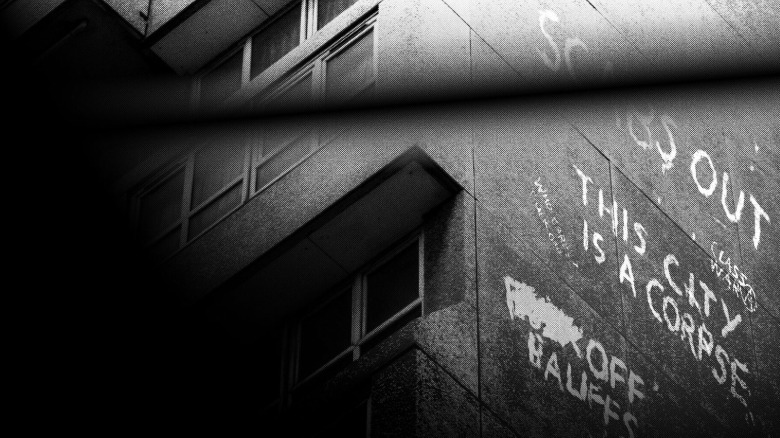
Signet City, the upcoming RPG from Citizen Sleeper developer Gareth Damian Martin, will cast players as a parasite. Set in a brutalist, monochromatic gotham at the edge of collapse, this entity will take control of different human hosts, directing their actions and accomplishing its own objectives. When asked what cultural touchpoints inspired the self-described "fungalpunk" RPG, Damian Martin points to their own British upbringing, and the desire to "create something that would draw on that identity and history" — even if some of it might go over the heads an American audience.
Before they began designing video games, they worked at a theater design company doing pre-visualization work. One production involved Sting's The Last Ship — a musical about the shipbuilding crisis in Newcastle in the 1980s. "There are these amazing pictures of Newcastle in the '80s of these huge ships towering over little terraced houses," they recall. "I remember thinking at the time that was science fiction happening in the past. There's something really interesting in that moment in history where industrialization collapsed. It's obviously cast a very long shadow over the UK."
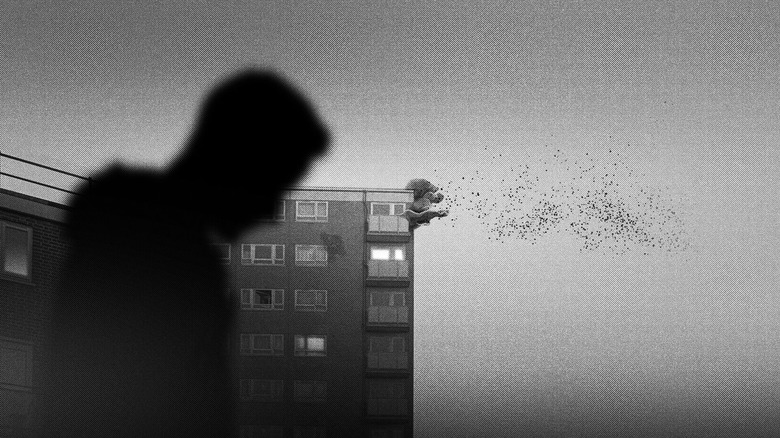
Damian Martin envisioned an alternate universe 1980s northern British city in a series of sketches for Inktober. "Ever since I've been daring myself to make the video game version of that [series]," they say. One of those drawings, titled "The Algae Burners," depicts a building that will appear in the game. For now, you can see a glimpse of it in Signet City's first trailer above.
The Winter of Discontent, one of the most critical moments in recent British history, was also a "starting point" for Signet City. As Damian Martin explains, it was both a "kind of labor struggle" and "ecological event." Between 1978 and 1979, the United Kingdom experienced its coldest winter in 16 years, which coincided with workers across the country striking to secure better pay. The combination of those things led to severe disruptions to the economy, and the subsequent downfall of then British Prime Minister James Callaghan, whose Labour Party lost the 1979 general election to the Conservative Party and Margaret Thatcher. A decade of Thatcherism would follow, and the rest, as they say, is history.
"In the UK, it really is such a key moment," says Damian Martin. "Like almost all of the political dialogues are arranged around what happened in the '80s."
They were also inspired by British social photography of the '80s and in particular the work of photographer Tish Murtha. Like Sting, Murtha had a close connection to Newcastle, where she spent much of her professional career photographing the city's working-class and marginalized communities. In her famous Youth Unemployment series, Murtha documented the devastating effect Thatcher's free market policies had on the north of England, as well as the the resilience and resourcefulness of the people who the government had abandoned.
How do the mushrooms fit in alongside British history? However incongruously, Damian Martin also found inspiration in Tetsuo: The Iron Man. In the Japanese cult classic, a man is slowly overtaken by machinery, becoming a grotesque hybrid of metal and flesh. "The director always was weirdly insistent that it's a superhero film," Damian Martin says. Looking back, "it makes so much sense, because it's about a powerless character becoming powerful over time, but that process of becoming powerful is distorting and scary, and destroys like him to some extent."
 Jump Over the Age
Abara — the 2005 manga from Blame! and Knights of Sidionia creator Tsutomu Nihei — was also a visual reference. "There are these early bits in Abara where there are these big, weird, almost fungal-looking kinds of monsters, but they're made of bone," Damian Martin explains.
Where the prose itself is concerned, Damian Martin points to literary works of New Weird authors like China Miéville and Jeff VanderMeer. "I'm really trying to put the player in this position where they have to understand the world through this paradigm that is fundamentally inhuman," they say. "When you have a host, you have your own objectives as a parasite, and the host has their life and things that are happening to them." They decided to write the game from two perspectives: the parasite (second-person, like a traditional RPG protagonist) and third (the host's thoughts). Damian Martin's goal is to produce an "overlapping quality" to the experience of navigating through the game's story. As the parasite, you'll use a resource called emotion to affect the actions of your hosts.
"Sometimes I feel like I'm the only person who thinks about these things together," Damian Martin says jokingly of all of Signet City's disparate influences, which by their own admission pull from sources that are alternatively "quite real and human" and more supernatural.
Players will get a chance to see how all those come together sometime hopefully next year. Until then, you can wishlist Signet City on Steam.