The astronaut wears Prada.
Axiom Space
The human body and the vacuum of space aren't a good match. Without protection, space would have its way with you. You'd be unconscious in around 15 seconds. Within minutes, you'd be dead. So, you want to be wearing the right suit. Astronauts on NASA's Artemis III and IV missions will wear a new one designed by Axiom Space, with an assist from... Prada?
The inner suit
Axiom
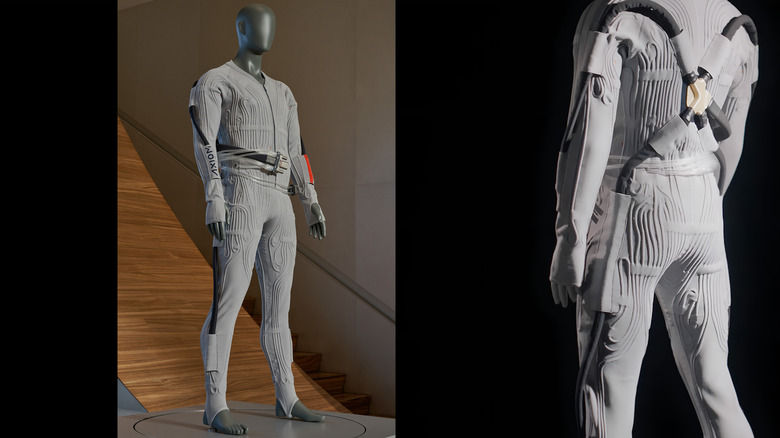
Underneath the bulky white spacesuits we're all familiar with, astronauts wear a tight-fitting undergarment called the Liquid Cooling and Ventilation Garment (LCVG). Think of it as the spaceman's long johns. While past versions of this inner suit looked like the world's most expensive pajamas, this new version more closely resembles a sleek superhero outfit.
While the new suit's Marvel aesthetics may help with NASA's marketing (and therefore funding), its intricately woven tubing is more practical. Without it, you'd quickly die of heatstroke and organ failure. See, in space, body heat has nowhere to go without active cooling. And missions on the lunar surface require plenty of physical effort, which would only hasten your demise.
The LCVG's tubes circulate cold water across your major muscle groups, absorbing your metabolic heat. They then pump it out to the oversized backpack known as the portable life support system. There's even a fully redundant cooling circuit in case the primary one fails. Always nice to have a backup.
So, where does Prada come in? Axiom suggests the Italian fashion house's expertise in engineered knitting and manufacturing capabilities were big draws. But it's probably no coincidence that Prada's onstage representative at the unveiling was its chief marketing officer. For better or worse, people are more likely to care when they see something that looks more like Steve Rogers's suit than a pair of tubed-up long underwear.
The outer suit
Axiom Space
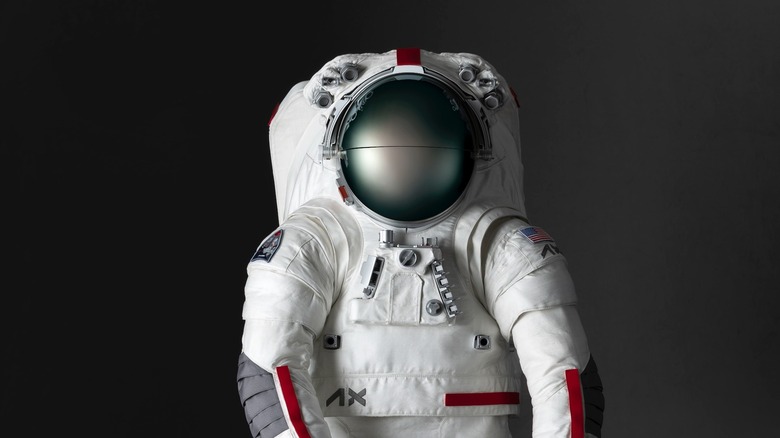
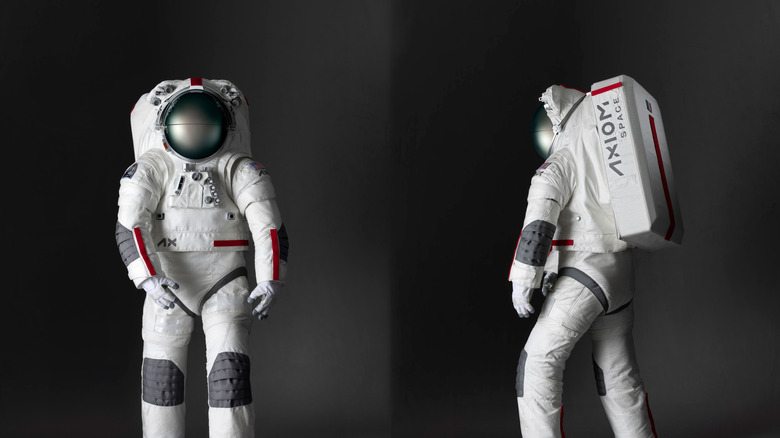
Now we get to the the bulky white outer suit we see on TV. Meet the Axiom Extravehicular Mobility Unit (AxEMU), another Prada collab. This external spacesuit's most important function is pressurization. Without it, let's just say you wouldn't be in for a fun time.
Under extremely low pressure, the air in your lungs would expand and tear tissues. Meanwhile, because liquids have lower boiling points in space, water in your muscles would vaporize, leading you to swell up like Violet Beauregarde. And with bubbles forming in your blood, your circulation would fail within about a minute.
Since astronauts typically want to continue living, the outer suit is designed to maintain a safe, comfortable pressure. Its white material reflects solar heat while protecting against lunar dust. (Those fine particles can linger in the lungs for months.)
The outer suit adds more tubing to the mix. A ventilation loop from the backpack blows fresh oxygen into the helmet and across your face. As pleasant as that sounds, it serves a more critical purpose: to prevent you from suffocating from an excess of your own carbon dioxide. This process washes away the exhaled CO2, routing it to the life support system (again, that's the backpack), which filters it and recirculates breathable oxygen. Like the inner suit, the outer one includes redundant safety systems in case of failure.
The AxEMU is built for spacewalks of over eight hours. It's also designed to support a wide range of body types, from the 1st to the 99th percentiles for males and females. (That's a big departure from the custom Apollo-era suits.) Advanced coatings on the helmet and visor enhance astronauts' vision. And there are even custom in-house gloves "featuring several advancements over the gloves used today," according to Axiom.
To the moon
The Artemis III mission, scheduled for 2027, will serve as a test run for the new suit (and new lunar landers) in near-Earth orbit. That leads up to the main event. Artemis IV, currently scheduled for 2028, which will mark the first crewed Moon landing since Apollo 17 in 1972.
It will also mark the first human exploration of the lunar south pole. There, the suit will have to handle extreme cold as the astronauts spend about a week collecting samples and searching for water ice. Axiom says the suit is designed to withstand the coldest temperatures at the pole for at least two hours. Whether they find it or not, at least they'll look like badass superheroes doing it.