The last time the agency heard from the probe was in December.
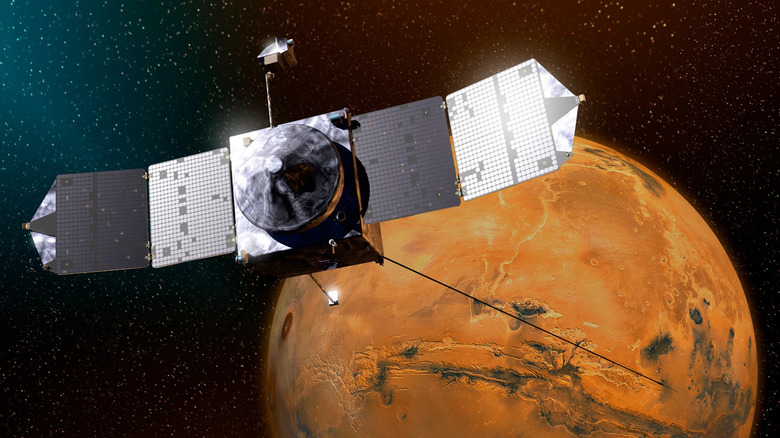
NASA/Goddard/University of Colorado/Laboratory for Atmospheric and Space Physics
NASA has officially ended the Mars Atmosphere and Volatile Evolution (MAVEN) mission, six months after it lost contact with the probe. MAVEN was the agency's first program dedicated to studying the Martian atmosphere and its evolution. It launched in 2013 from Cape Canaveral and entered the Martian orbit nearly a year later in 2014. The probe's primary science mission was scheduled to last one year, but it ended up spending more than 11 years in orbit, sending back data from Mars. NASA even used it as an antenna for the Mars 2020 mission, which brought the Perserance rover to the planet.
The last time the agency heard from MAVEN was on December 6, 2025, before it suddenly lost signal after passing behind Mars. But NASA didn't quickly give up on the probe and examined its options first. It formed an anomaly review board in February to assess MAVEN's probable state and to figure out if there are any viable ways to recover it. Unfortunately, the board ultimately determined that the spacecraft is no longer able to perform science missions and to relay data back to Earth.
NASA says the probe was working properly before it passed behind the Red Planet, but the Deep Space Network, the agency's global array of international ground antennas, couldn't observe a signal after it had reappeared. Based on the data provided by the network, MAVEN was in safe mode and rotating at an unusually high rate after emerging from behind the planet. That drained its batteries and caused its communications system to lose power. The agency is still reviewing data to figure out the root cause of the anomaly and will publish a report later this year.
MAVEN's observations allowed NASA to determine that solar winds and solar storms continue to strip away the Martian atmosphere and were the main reasons why the planet's climate went from potentially habitable to cold and arid. They showed that protons can create new kinds of auroras on Mars, and that they could occur anywhere on the planet, whereas they can only occur near the poles here on Earth. MAVEN also helped scientists understand how a series of dust storms that enveloped the whole planet led it to lose water molecules to space.