You get a waiver! You get a waiver!
shine.graphics/Shutterstock
The Trump administration has roundly criticized America's technological sector for its dependence on international partners. In its 2025 National Security Strategy, the administration named securing independent supply chains a pillar of its economic and national security policies, warning that the US "must never be dependent on any outside power for core components." Perhaps nowhere have these concerns been more acute than in the home router market, where the White House has put considerable energy into untethering America's Wi-Fi networks from foreign manufacturers.
In March 2026, the FCC banned all international home internet routers, citing how "malicious actors have exploited security gaps in foreign-made routers to attack American households, disrupt networks, enable espionage, and facilitate intellectual property theft." Citing recent cyberattacks like Salt Typhoon, Volt and Flax, the FCC's National Security Determination argues that companies manufacturing routers can inject backdoors into their products, giving foreign intelligence agencies and hackers unfettered access to American networks. To ward of such intrusions, the Trump administration has pushed the FCC to ban any router whose components, assembly, or designs were produced overseas. And while firms are allowed to continue selling routers currently on the market, the FCC barred them from providing software updates to their existing customers after 2027.
Already, the ban has hit several roadblocks, as the FCC looks to implement a ruling that many critics warned was unrealistic. In May, the FCC issued a public notice that routers can "continue to receive software and firmware updates that mitigate harm to U.S. consumers" until at least January 1, 2029. The move comes after the National Consumer Technology Association pushed the FCC to relax its stringent ruling, citing supply chain shortages "in critical substrate material and memory modules" that could cause "disruptions to millions of Americans' broadband services." Critics pointed to the revision as an indication of the contradictions inherent in the restrictions, noting that banning software updates could cause more security problems than it solves. As it stands, a wholly-domestic router supply chain may merely be wishful thinking.
An international affiar
Skrypnykov Dmytro/Shutterstock
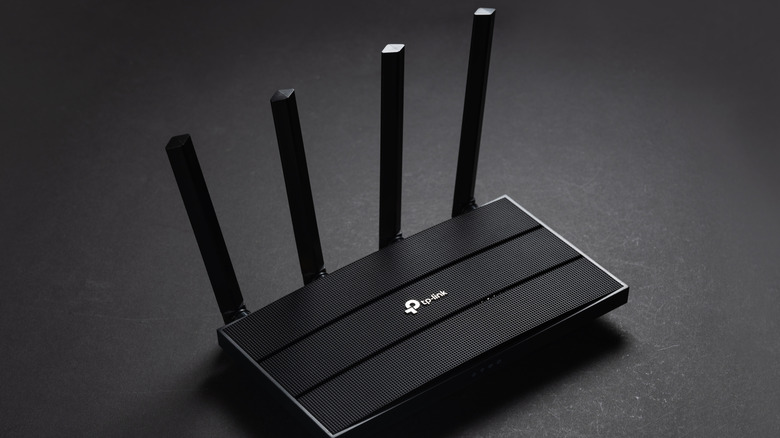
America's router market relies on foreign partners, particularly from Southeast Asia, to source and design its products. The market's largest company, Chinese router giant T.P. Link, has been in the FCC's crosshairs for years, with the Administration attempting to to ban the firm's popular products outright in 2025. As it stands, T.P. Link produces roughly 35% of America's home routers, down from over 60% in 2024. Popular international firm ASUS is based in Taiwan, whose ZenWiFi Pro tested as one of the best mesh Wi-Fi routers of 2026. Synology and D-Link are also based in Taiwan and thus subject to the FCC's restrictions.
In the wake of the ruling, T.P. Link met with the FCC to secure conditional approval for its routers. During the meeting, the Chinese manufacturer argued that it is "investing hundreds of millions of dollars to bring manufacturing and research and development of its consumer routers to the U.S." through its Irvine, California-based subsidiary. However, the solution for international firms like T.P. Link and ASUS isn't as simple as moving their manufacturing plants stateside. Critically, the FCC's enforcement applies to all products whose design processes occur internationally. Under the ruling, firms will have to move the full scope of their operations to the United States or seek a waiver from the FCC.
But not even America's domestic brands meet these strict domestic manufacturing standards, as all major American brands depend on international partners to source and construct their products. Google, for instance, makes its Nest routers in Vietnam and China. Netgear, meanwhile, splits its operation between Vietnam and Taiwan. Ubiquiti and Amazon also depend on international. Another major American brand, is Irvine, California's Linksys, is owned by Taiwanese giant Foxconn and manufactures its products in Vietnam.
Some have pointed to SpaceX's Starlink system as the blueprint for an American-made router market. Reportedly, the Austin company builds its routers in Bastrop, Texas. However, even SpaceX is not necessarily beyond the reach of the FCC's ruling, as the firm has relied on Vietnamese partners for its router components since at least 2024.
The future of American routers

Ljupco/Getty Images
The future of the American router market remains murky. As it stands, the FCC's regulations bar any company from selling new foreign-produced routers that haven't previously received approval from the United States government. With that said, firms can sell routers already on the market. This uncertain regulatory framework, when paired with the FCC's willingness to extend deadlines and grant conditional approvals, further muddies the market's opaque waters.
To date, at least 11 companies have received waivers to sell their routers in the United States through 2027. For instance, the FCC granted popular American router company Netgear a waiver to sell its consumer mesh, mobile, and standalone routers. The approval extends to both the company's Nighthawk and Orbi lines, as well as its cable CAX and Cable CM systems. Amazon's Eero and Nokia are two other major brands to gain a similar reprieve. Arcadyan Technology, who manufactures routers for T-Mobile, AT&T and Verizon, was also granted a waiver in June. With the FCC continuing to issue approvals for companies like Hitron Technologies and Vantiva, the administration appears willing to continue to ease its restrictions.
Critics continue to question the logic behind the administration's router crackdown. For one thing, advocates note that the ban does little to protect consumers who already own foreign-made routers. Taken at face value, the FCC's implication that international routers create backdoors into American networks does little to assuage the concerns of the millions of consumers that currently rely on foreign routers. Moreover, discontinuing software support is likely to only heighten security concerns, making it easier for hackers and foreign intelligence agencies to crack the country's collective cyber security framework. According to the Electronic Frontier Foundation, the lack of targeted enforcement, and the ability to seek conditional approvals, is likely to magnify problematic trends in the consumer router market, arguing that it "entrenches existing players and deepens problematic quid-pro-quo arrangements."
Given the market's dependence on international components, the FCC will likely continue to face pushback. Of course, these growing pains may be a feature of the FCC's ruling, rather than a bug. By dolling out ad-hoc exceptions to a blanket ban, the administration is blocking Chinese competitors from the market while forcing manufacturers to stay on its good side. An opaque approval process further muddies the waters, with consumers receiving little detail regarding the logic behind these exceptions. As companies continue to court the FCC for approval, their customers may be stuck holding the speculative bag, as they wait to hear if their chosen brand will make the cut.