Business Today / YouTube
Do you ever feel like you're living in the early chapters of a dystopian sci-fi story? As if AI, mass surveillance, and the increasing concentration of wealth weren't enough, now we have freakin' robots to contend with. And these things always start out appearing harmless, right? That's the backdrop of Japan Airlines' (JAL) decision to deploy androids to help its human baggage handlers.
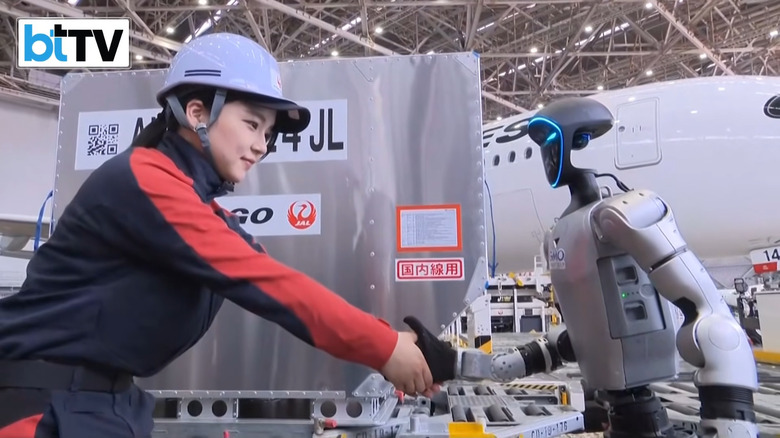
The humanoid robots will be part of a test that kicks off in May (via The Guardian), moving luggage and cargo at Tokyo's Haneda Airport. At a JAL press event this week, a droid was seen gently nudging cargo onto a conveyor belt and waving to a human coworker. At another point, it shook hands with another human colleague, which illustrated its size: It's only 4 feet, 3 inches tall. (Danny DeVito has seven inches on that tin man!) The androids can operate for two to three hours per charge.
The trial will roll out in several phases, so the androids won't be doing live work right away. First, JAL will map and analyze airport conditions to identify where they can work safely alongside people. Then, the robots will undergo test runs in simulated airport environments before eventually joining human workers on the tarmac. If all goes as planned, they could eventually be used for other tasks, including cleaning aircraft cabins.
Automation typically involves taking jobs away from people. But what about when a country faces a labor shortage? Japan's unique conditions make it an intriguing test bed, with its rapidly aging population and low birth rate leading to a diminished workforce. And with political pressure to curb immigration (sound familiar?), the circumstances are practically tailor-made for corporations to rationalize sending in the androids. Ho, boy.
Regardless of how this (seemingly harmless) trial run turns out, Silicon Valley is eyeing human-like robots as one of its next big projects. Androids in the workforce is a Pandora's box that we'll be forced to reckon with in the coming years. Let's just hope our timeline turns out better than the versions our sci-fi prophets repeatedly warned us about.